
← Blog · 2 September 2026
Using Your EV as Backup Power in Tasmania: V2L Explained
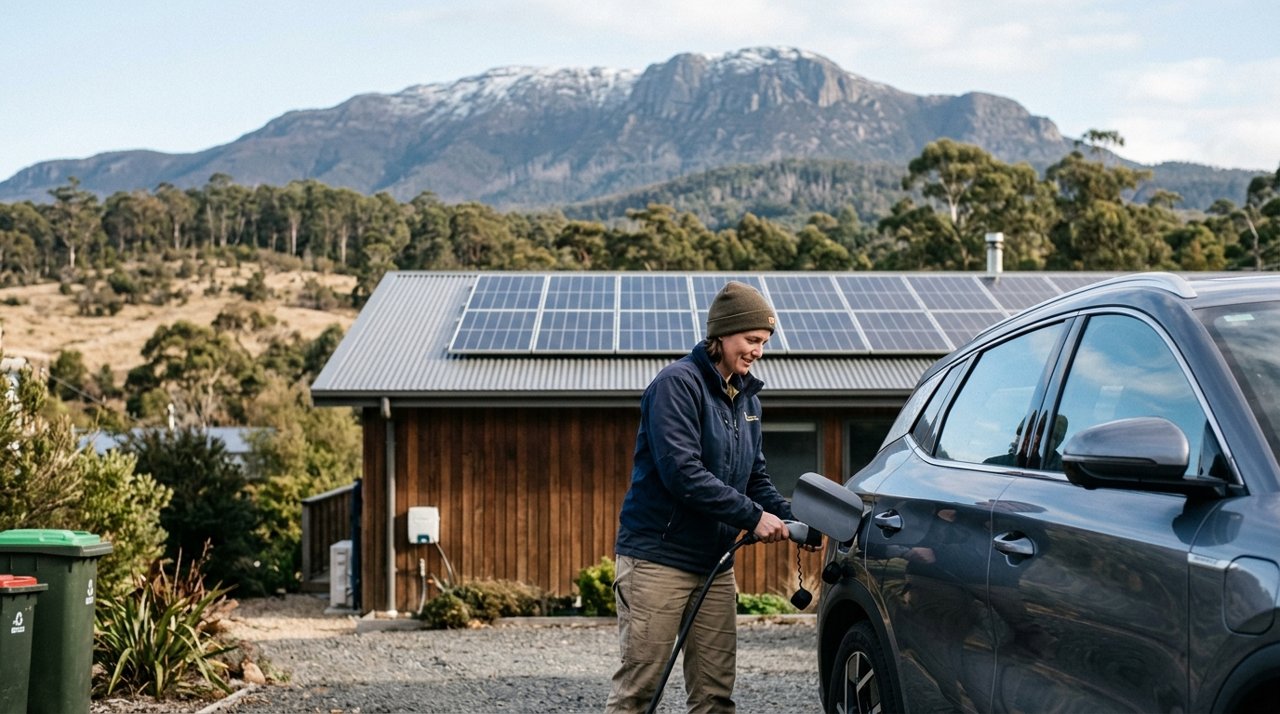
Yes — if your electric car supports vehicle-to-load (V2L), you can plug ordinary household appliances straight into it and keep essentials running during a blackout. Many Tasmanian EV owners already do exactly this during storm outages, using the car’s large battery to run a fridge, lights, internet and phone charging for days at a time.
It’s not science fiction, and it’s not a future feature waiting on government approval. V2L works today, off the shelf, with nothing more than an adaptor or a built-in socket. The catch is that it powers appliances, not your whole house — and there are some important safety rules, which we’ll cover below.
What exactly is V2L — and how is it different from V2H and V2G?
V2L (vehicle-to-load) means using your EV’s battery as a portable power point: you plug devices into the car via an adaptor or built-in socket, typically supplying around 2 to 3.6 kW depending on the vehicle. It’s the simplest member of a family of “bidirectional” tricks:
- V2L (vehicle-to-load): plug appliances into the car. Available now on several popular EVs in Australia. No electrician needed for basic use.
- V2H (vehicle-to-home): the car powers your whole house through a special bidirectional charger and switchboard gear. This needs approved hardware, a licensed electrician, and network sign-off — it’s only just becoming available in Australia and isn’t yet common in Tasmania.
- V2G (vehicle-to-grid): the car exports power to the grid, usually as part of a retailer program. This depends on your retailer and network offering it, and options in Tasmania are currently limited.
For most Tasmanian households today, V2L is the practical option. V2H is worth watching, but the hardware and approvals are still maturing.
Which EVs can do V2L?
Quite a few EVs sold in Australia include V2L, but not all — so it’s worth checking the spec sheet before you buy. As a general guide:
- Many BYD models (including the Atto 3 and Shark 6 ute), MG models like the MG4, and the Hyundai Ioniq 5/6 and Kia EV6/EV9 offer V2L, usually via an adaptor that plugs into the charge port or a socket inside the car.
- Tesla vehicles currently do not offer V2L.
- Output is typically limited to roughly 10–15 amps — enough for appliances, not for a whole house.
If backup power matters to you, treat V2L as a genuine buying criterion when comparing EVs, the same way you’d compare range or boot space.
What can I actually run during a blackout?
A typical V2L outlet will comfortably run the essentials that matter most in a Tasmanian winter outage: your fridge and freezer, lights, modem and phone chargers, a TV, a laptop, or a small heater. Because EV batteries are large (commonly 50–80 kWh), even a long outage is manageable — running just a fridge, lights and internet might use only a small fraction of the battery per day.
What you generally can’t run is the big stuff: electric hot water, a heat pump or air conditioner at full tilt, an oven, or an EV charging off itself. Think “keep the household ticking over”, not “life as normal”.
A practical hierarchy during an outage:
- Fridge and freezer (food safety first)
- Internet modem and phone charging (staying informed)
- Lighting
- Medical devices, if anyone in the home relies on them
- Comfort items — TV, a small heater — as the budget allows
How do I use V2L safely at home?
Used as intended, V2L is very safe: the car is essentially a big, well-engineered battery with a power point. The golden rules are simple:
- Plug appliances directly into the car’s V2L outlet or a heavy-duty extension lead. Use leads rated for the load, and keep connections out of the rain.
- Never, ever backfeed your house wiring by plugging the car into a wall socket with a double-ended lead (“suicide cord”). This is dangerous, illegal, and can kill a linesman working on the street.
- If you want the car to power hard-wired circuits, that requires a proper changeover switch or transfer equipment installed by a licensed electrician — the same standard that applies to generators.
- Keep an eye on the car’s state of charge so you keep enough range to drive somewhere if needed.
Is V2L a substitute for a home battery?
Not quite — they’re good at different jobs, and many electrified households will end up wanting both. Here’s the honest comparison:
| EV with V2L | Home battery | |
|---|---|---|
| Backup power | Manual — you plug things in; only when the car is home | Automatic switchover; always on |
| Storage size | Very large (often 50 kWh+) | Typically 10–13 kWh usable |
| What it powers | Individual appliances | Selected circuits or the whole home |
| Day-to-day bill savings | None while you’re out driving | Charges from your solar, discharges in the evening |
| Upfront cost | Included free on many EVs | Several thousand dollars, before any rebate |
The big difference is automation. A home battery quietly works for you every single day — storing your solar surplus and covering the evening peak — while V2L is a manual, outage-only tool. And of course, if the car is at the shops when the power goes out, it’s no help at all.
How does this fit with solar in Tasmania?
This is where the Tasmanian numbers matter. The regulated feed-in tariff (9.276 c/kWh from 1 July 2026, up from about 8.9c) is much lower than what you pay to import power (roughly 28–30 c/kWh on typical Aurora Energy residential tariffs). That gap means the real value of rooftop solar in Tasmania is using your own power, not exporting it.
A home battery is one way to lift self-consumption; charging an EV from solar is another — often an even bigger one, since the car can soak up far more surplus than a wall battery. Households that will electrify (EV, heat pump, induction cooking) are increasingly advised to size up front: around 13 kW of panels on a 10 kW inverter has become a common future-proof default, and TasNetworks allows a 10 kW single-phase inverter, so most homes don’t need three-phase. A smaller system can still make sense for a low-use home with no electrification plans — bigger isn’t automatically better.
On batteries, be clear-eyed about Tasmania’s economics:
- The federal Cheaper Home Batteries Program (from 1 July 2025) discounts eligible batteries by around 30% at the full rate — roughly $250 per usable kWh in 2026 for the first 14 kWh, with lower rates above that and a 50 kWh cap — if your battery and installation meet the program’s eligibility rules, and provided it’s paired with solar. There’s no separate Tasmanian state rebate, and the discount tapers each year to 2030.
- Tasmania’s relatively cheap power and fair feed-in tariff mean a battery generally pays for itself more slowly here than on the mainland — commonly quoted payback windows stretch much longer for the battery than for the panels, and individual results vary a lot with usage.
- No retailer-run VPP operates in Tasmania, though spot-price-passthrough retailing does exist, and automated battery control can take advantage of negative spot prices and peak avoidance.
In that context, V2L is a genuinely valuable freebie: if your EV already has it, you have most of the backup benefit of a home battery at no extra cost — which lets you judge a home battery purchase mainly on its bill-savings and convenience merits.
The practical takeaway
If you’re weighing up solar, a battery and an EV in Tasmania: prioritise a well-sized solar system sized for self-consumption, favour an EV with V2L when you buy, and treat a home battery as a separate decision on its own economics — because your car may already cover the blackout-backup box for free. Keep a quality extension lead and the V2L adaptor together somewhere you’ll find them in the dark.
This guide is written by the Tasmanian solar team at Solar Generation Tasmania as a free community resource — if any of it raises questions about your own place, they’re always happy to help you think it through.
#solargentas #solargen #solargenerationtasmania
Published by Solar Generation Tasmania. General information current as at publication — rebates, tariffs and prices change, so confirm current figures before deciding.
Thinking about solar for your place?
Tell us a little about your home and a local Tasmanian installer will put together a free, no-obligation assessment — system, battery and the rebates you qualify for.
- Honest advice for Tasmanian conditions (Zone 4 sun, hydro grid)
- We apply every rebate you’re eligible for
- Local installers — not a mainland call centre
- SAA-accredited, with degree-qualified owners and 10+ years in tech & solar