
← Blog · 28 August 2026
Off-Grid Solar for Tasmanian Shacks and Remote Properties
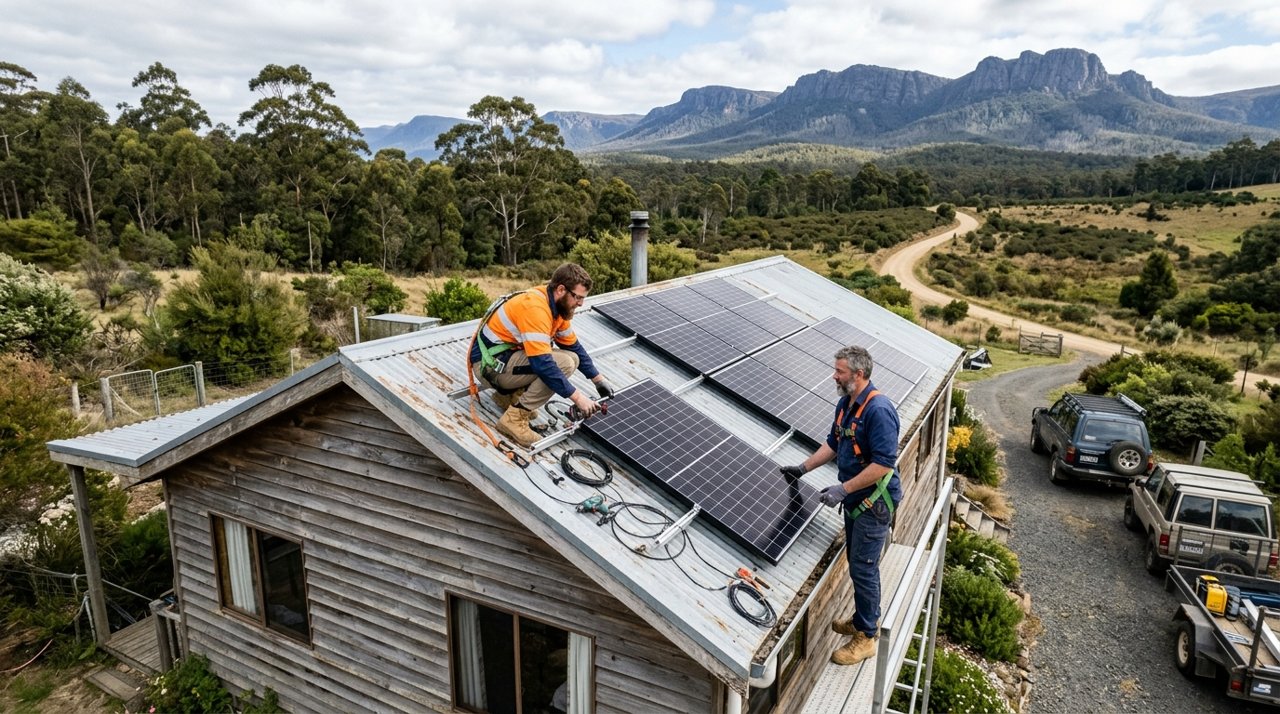
Going off-grid in Tasmania is absolutely doable, and for many shacks and remote properties it’s the most sensible way to get reliable power. But it’s a genuinely different beast from a standard suburban solar setup — you’re not just trimming a power bill, you’re building and running your own tiny power station. This guide walks through what’s involved, what it suits, and the honest trade-offs, so you can decide with clear eyes.
Is off-grid solar practical in Tasmania?
Yes — modern panels and lithium batteries make off-grid living very workable in Tasmania, even through winter, as long as the system is sized for your real needs and backed up sensibly. The catch is that off-grid systems cost more upfront than grid-connected ones, because batteries and a backup generator aren’t optional extras — they’re the heart of the system.
Tasmania’s climate is actually kinder to solar than many people assume. Our long summer days are excellent for generation, and panels perform well in cool conditions. Winter is the pinch point: shorter days, lower sun angles, and stretches of grey weather. A well-designed off-grid system plans for June and July first, and lets summer look after itself.
What’s actually in an off-grid system?
A grid-connected home uses the grid as a giant battery — exporting surplus, importing at night. Off-grid, you replace the grid with equipment you own. A typical setup includes:
- Solar panels, usually sized generously to charge batteries even on average winter days
- A battery bank, to carry you through nights and cloudy spells
- An inverter/charger, the brains that converts and manages power
- A backup generator (petrol or diesel) for long grey stretches or occasional big loads
- Monitoring, so you can see what you’re making and using at a glance
The key difference in mindset: with grid power, the system can be imperfect and the grid quietly covers the gaps. Off-grid, every gap is yours to cover, which is why honest load planning matters so much.
How big a system does a shack need?
It depends entirely on what you run — and most shacks run far less than a full-time home. Lights, a fridge, phone and laptop charging, a water pump, and maybe a TV add up to a modest daily load that a well-designed off-grid system can handle comfortably.
The heavy hitters are anything that makes heat: electric hot water, space heating, ovens and cooktops, and kettles running all day. Many off-grid Tasmanian households take the pressure off with:
- Wood heating (very common in shacks, and practically free if you collect your own)
- Gas cooking and gas-boosted hot water
- Efficient appliances and LED lighting
A useful first step is a simple load audit — listing everything you want to run and roughly when. That list, not guesswork, should drive the system size. A weekend-only shack needs far less than a place you’re moving into full-time, and it’s usually smarter to size for how you’ll actually live, with some room to grow.
Do you need a battery off-grid — and how much?
Yes, always. Off-grid, the battery is your night-time power supply and your rainy-day reserve, so it’s the single most important — and usually most expensive — part of the system.
How much storage you need comes down to two things: how much energy you use overnight, and how many days of gloomy weather you want to coast through without starting the generator. More battery means more comfort and less generator run-time; less battery means a lower upfront cost but more generator hours and more discipline on grey days. There’s no single right answer — it’s a comfort-versus-budget decision that a proper design conversation should map out against your load list.
How does the Tasmanian winter change the design?
Winter is what separates a well-designed off-grid system from a frustrating one. The standard tricks are all about stacking the odds in your favour during the shortest months:
- Oversizing the panel array relative to the inverter, so even weak winter sun harvests useful energy
- Tilting panels steeper where possible, to catch the low winter sun and shed leaf litter and grime
- Keeping trees trimmed — shading that barely matters in summer can gut winter output
- Having a generator you don’t resent, sized to recharge the batteries efficiently during long grey spells
Most off-gridders find their generator runs very little for nine or ten months of the year, then earns its keep in short bursts through mid-winter. That’s a healthy pattern, not a failure.
What rebates can Tasmanians get in 2026?
Two federal programs can reduce the upfront cost, subject to eligibility rules, and there is currently no separate Tasmanian state battery rebate.
- The federal STC rebate (SRES): discounts eligible solar systems upfront. Tasmania sits in STC Zone 4, and eligible off-grid systems can generally access it — your installer claims it as a point-of-sale discount, subject to program conditions.
- The Cheaper Home Batteries Program (from 1 July 2025): takes roughly 30% off an eligible battery — roughly $250 per usable kWh in 2026 at the full rate for the first 14 kWh, then a reduced rate for capacity beyond that, up to a 50 kWh cap. The discount tapers each year to 2030, the battery must be paired with solar, and eligibility depends on the program’s rules — so treat any figure as conditional and confirm before you commit.
Rebates change over time and eligibility is never guaranteed, so it’s worth checking the current settings when you’re ready to buy rather than relying on what a mate paid last year.
Should you go off-grid if power lines are nearby?
Not automatically. Get a connection quote first — if the grid is genuinely close, staying connected is usually cheaper and simpler, and off-grid only clearly wins when connection is long, difficult, or surprisingly expensive, as it often is on remote or bush blocks.
Here’s the honest comparison for a typical household:
| Grid-connected solar (+ battery) | Full off-grid | |
|---|---|---|
| Upfront cost | Lower; batteries optional | Higher; batteries and generator essential |
| Reliability | Grid covers the gaps | You own every gap — design and backup matter |
| Ongoing cost | Bills continue, offset by solar self-consumption | No power bills, but generator fuel and eventual battery replacement |
| Best for | Homes near existing lines | Shacks and blocks where connection quotes are eye-watering |
For context on the grid-connected side: Aurora Energy’s regulated feed-in tariff is 9.276 c/kWh from 1 July 2026, while retail import prices sit roughly around 28–30 c/kWh — so the savings live in using your own solar, not exporting it. Many Tasmanian households see payback in the rough range of four to six years on solar, depending on how much they self-consume, while batteries take longer — often in the seven-to-twelve-year range — because Tasmania’s relatively cheap power and fair feed-in tariff soften the economics. There’s no vendor VPP operating in Tasmania, though spot-passthrough retail plans do exist, and automated battery control can take advantage of them; for a typical Aurora household, a battery’s value is mainly self-consumption plus blackout backup.
A very low-use shack that only needs lights and a fridge may genuinely suit a small, simple off-grid setup even with the grid nearby — the load list decides.
What’s the smartest first step?
Before spending a dollar, do two things: write down your real load list, and — if the grid is anywhere within reach — get an actual connection quote so you’re comparing real numbers, not guesses. With those two in hand, the off-grid-versus-connect decision usually makes itself, and the system design becomes a matter of matching equipment to the life you actually live.
And a practical takeaway: whatever you build, make it easy to expand. Energy needs almost always grow — an EV, a heat pump, family staying longer — and leaving headroom in your panel space and switchboard now is far cheaper than retrofitting later.
This guide is written by the Tasmanian solar team at Solar Generation Tasmania, who live and work here and are always happy to help answer questions from fellow Tasmanians weighing up their options.
#solargentas #solargen #solargenerationtasmania
Published by Solar Generation Tasmania. General information current as at publication — rebates, tariffs and prices change, so confirm current figures before deciding.
Thinking about solar for your place?
Tell us a little about your home and a local Tasmanian installer will put together a free, no-obligation assessment — system, battery and the rebates you qualify for.
- Honest advice for Tasmanian conditions (Zone 4 sun, hydro grid)
- We apply every rebate you’re eligible for
- Local installers — not a mainland call centre
- SAA-accredited, with degree-qualified owners and 10+ years in tech & solar