
← Blog · 1 September 2026
How Solar Cuts Your Home Electricity Bill in Tasmania
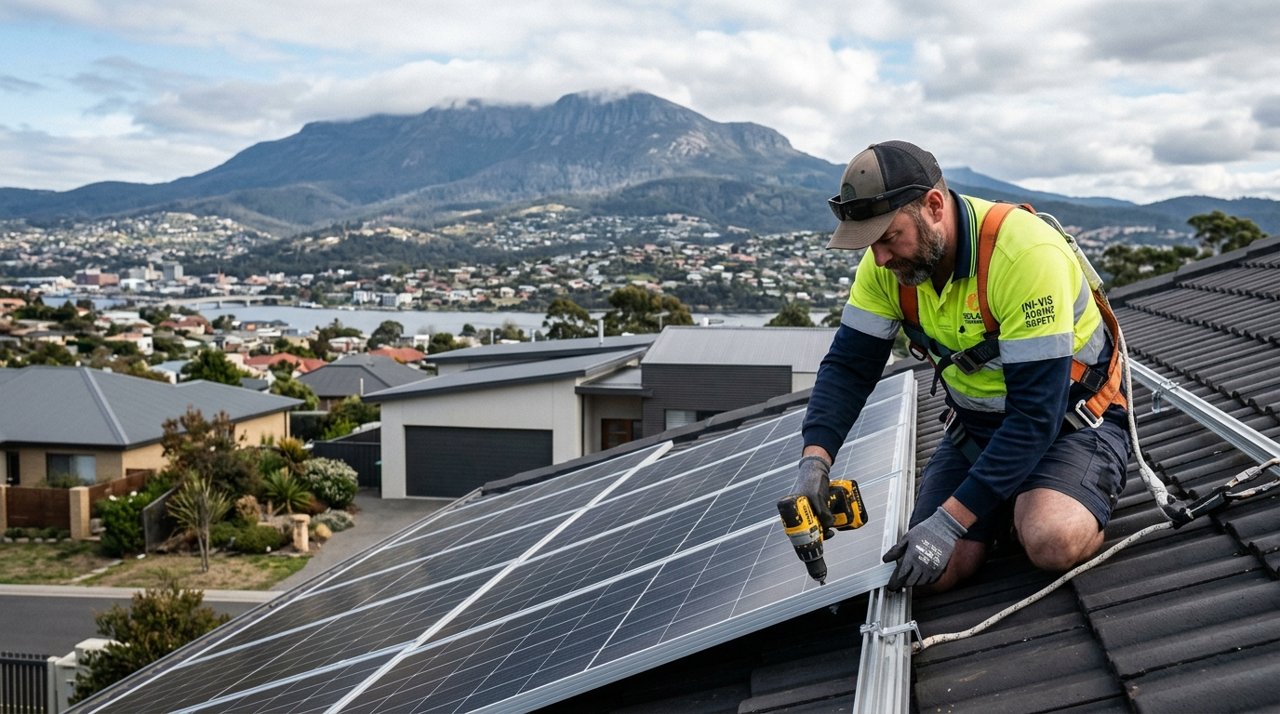
Solar cuts your Tasmanian power bill mainly by letting your home run on free electricity you make yourself — not by selling power back to the grid. Every kilowatt-hour (kWh) your panels produce that you actually use is one you don’t have to buy at the retail rate, which is roughly 28–30 cents per kWh for most households. Power you send back to the grid earns a much smaller feed-in tariff, so the real art of saving with solar in Tasmania is self-consumption: using your sunshine while it’s shining.
How much can solar actually save me?
That depends on how much of your solar generation you use in the home, your tariff, and your system size — there’s no single honest number. As a rule of thumb, the more of your daily usage you can shift into daylight hours, the bigger the dent in your bill, because each self-consumed kWh avoids paying the full retail rate.
Here’s the core maths every Tasmanian solar owner should understand:
| What happens to a solar kWh | Rough value to you |
|---|---|
| You use it at home (self-consumption) | Avoids buying power at roughly 28–30 c/kWh |
| You export it to the grid | Earns the regulated feed-in tariff — 9.276 c/kWh from 1 July 2026 |
That gap — avoiding roughly three times what you’d earn exporting — is why sizing, timing and your household habits matter more than any headline claim.
How does the feed-in tariff work in Tasmania?
Aurora Energy, the main residential retailer, pays you a regulated feed-in tariff for solar you export. From 1 July 2026 that rate is 9.276 cents per kWh, up slightly from around 8.9 cents. It’s a fair return for spare power, but it’s deliberately modest next to the retail price — think of exports as a nice bonus, not the reason to go solar.
What size solar system should I get in Tasmania?
For most homes planning to electrify — an EV, a heat pump, induction cooking — around 13 kW of panels on a 10 kW inverter is the sensible, future-proof default. This uses the 133% oversizing rule, which lets you install up to a third more panel capacity than your inverter’s rating, and it keeps you well supplied on Tasmania’s many cloudy days.
It’s worth being honest here: this is a step up from the old 6.6 kW “standard” system, and it’s not right for everyone.
- Going big (around 13 kW) suits homes that use decent amounts of power, plan to add an EV or heat pump, or want a battery later.
- Staying smaller can suit a very low-use household with no electrification plans — a smaller, cheaper system that mostly covers daytime use may pay back just as well.
A good installer will look at your actual usage before recommending a size.
Do I need three-phase power for solar?
Usually not. TasNetworks allows a 10 kW inverter on a normal single-phase connection in Tasmania, which covers the ~13 kW setup above. Most homes can go properly big on solar without the cost and hassle of a three-phase upgrade.
What rebates are available in Tasmania?
Two federal programs do the heavy lifting, and both are subject to eligibility rules — always check your own situation rather than assuming you qualify.
The STC rebate (Small-scale Renewable Energy Scheme) discounts the upfront cost of your panels. Tasmania sits in STC Zone 4, and the rebate is usually handled as a point-of-sale discount by your installer. It’s a significant chunk off the system price, though it steps down gradually each year.
The Cheaper Home Batteries Program, running since 1 July 2025, takes roughly 30% off an eligible battery — around $250 per usable kWh in 2026 at the full rate for the first 14 kWh, then 60% of that rate for 14–28 kWh and 15% for 28–50 kWh, capped at 50 kWh. The battery must be paired with solar, and the discount tapers each year until 2030.
Worth knowing: there is no separate Tasmanian state battery rebate — the federal program is it.
Is a home battery worth it in Tasmania?
Honestly? Batteries pay back more slowly here than on the mainland, and it’s important to go in with clear eyes. Tasmania’s relatively cheap power and fair feed-in tariff mean the financial gap a battery exploits is narrower. For a typical household on a standard Aurora tariff, a battery’s value is mostly extra self-consumption plus blackout backup — and many households see the battery portion of their system take roughly 7–12 years to pay for itself, if it does within its warranty life at all.
A few honest extras:
- No vendor or retail Virtual Power Plant (VPP) program currently operates in Tasmania.
- Wholesale-price exposure does exist through spot-passthrough retailing, where an automated battery can charge when spot prices go negative and dodge peak imports. Solar Generation runs exactly this kind of automation on its own systems — but it’s a different retail model and not for everyone.
If blackout protection or energy independence matters to you, a battery can still make sense — just buy it for the right reasons.
How long does solar take to pay for itself?
For the solar panels themselves, many Tasmanian households see a payback in roughly the four-to-six-year range — though your own figure depends on your system cost after rebates, how much solar you self-consume, and your tariff. The battery portion, if you add one, typically takes considerably longer, as noted above.
Either way, panels keep producing for decades, so the years after payback are where the real value lands.
How do I get the most out of my solar?
Self-consumption is a habit as much as a hardware choice. Some practical moves:
- Run the dishwasher, washing machine and dryer during the day, using timers if you’re out.
- Put your hot water on a solar timer or diverter so it heats from your panels, not the grid.
- Charge your EV in daylight hours when you can — even weekend top-ups help.
- If you have a heat pump, pre-heat or pre-cool the house while the sun’s up.
- Keep panels clean and unshaded; Tasmanian trees grow faster than you think.
What’s the one thing to remember?
Solar in Tasmania pays for itself by replacing power you’d otherwise buy — not by what you sell. Size your system for the home you’re becoming (EV, heat pump, all-electric), shift your usage into daylight hours, claim the federal rebates you’re eligible for, and treat a battery as a comfort-and-backup choice first and a financial one second. Get those fundamentals right, and solar is one of the most reliable money-savers a Tasmanian household can make.
This guide was written by the Tasmanian solar team at Solar Generation Tasmania as a free community resource — if you’ve got questions about going solar, we’re always happy to help you think it through.
#solargentas #solargen #solargenerationtasmania
Published by Solar Generation Tasmania. General information current as at publication — rebates, tariffs and prices change, so confirm current figures before deciding.
Thinking about solar for your place?
Tell us a little about your home and a local Tasmanian installer will put together a free, no-obligation assessment — system, battery and the rebates you qualify for.
- Honest advice for Tasmanian conditions (Zone 4 sun, hydro grid)
- We apply every rebate you’re eligible for
- Local installers — not a mainland call centre
- SAA-accredited, with degree-qualified owners and 10+ years in tech & solar