
← Blog · 29 August 2026
Do You Still Need a Generator with Off-Grid Solar in Tasmania?
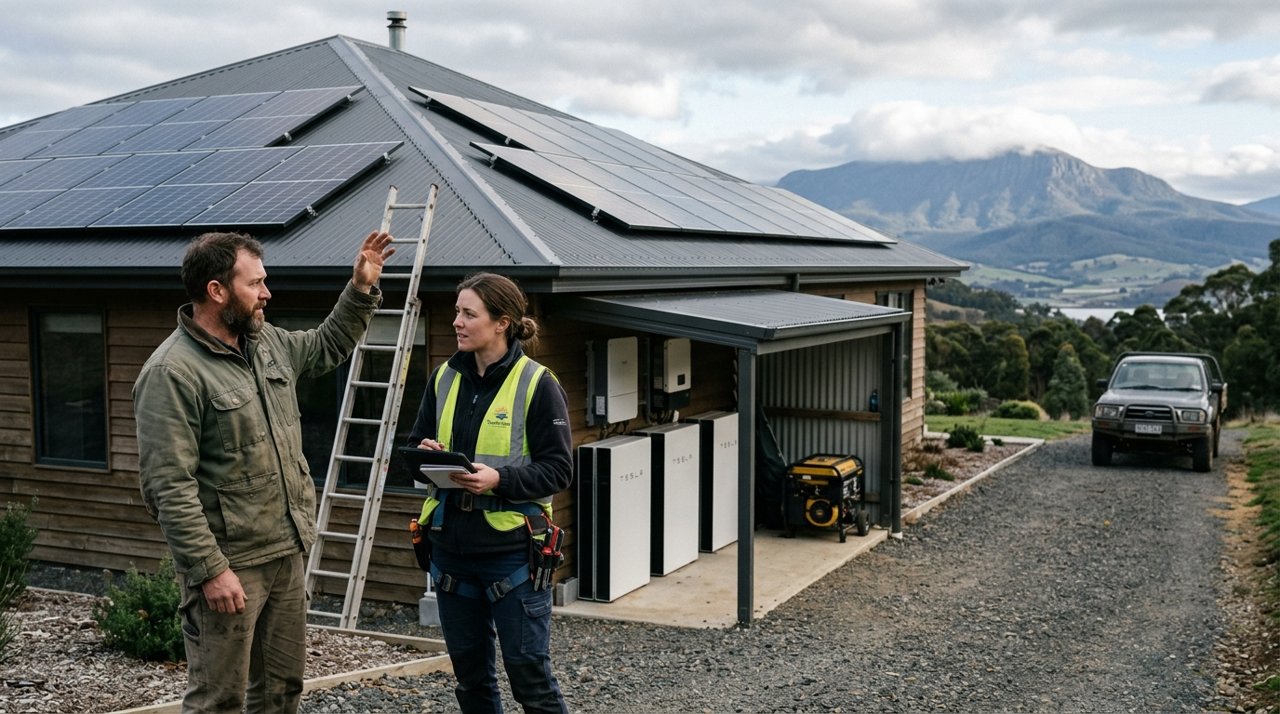
Going off-grid in Tasmania is absolutely achievable — but for most households, a generator still earns its place as a backup, not a workhorse. Tasmania’s long, cloudy winters can stretch even a well-sized solar and battery system, so the honest answer is: plan for a generator, then aim to rarely use it. Here’s how to think it through.
Do you still need a generator with off-grid solar?
In most Tasmanian cases, yes — as an occasional backup rather than a daily driver. A properly sized solar array and battery can carry a typical home through the milder months with ease, but winter is the pinch point. Short days, low sun angles and weeks of heavy cloud can leave batteries running low just when heating demand is highest.
A modest generator, used occasionally in winter, is usually far cheaper than buying enough extra panels and batteries to guarantee power through the darkest fortnight of June. Many off-grid households find that combination — solar and battery first, generator as the safety net — gives them reliability without overspending.
Why is winter the weak point for Tasmanian solar?
Tasmania’s solar resource is seasonal. Summer generation is excellent; winter generation is a fraction of it. On-grid, that barely matters — you simply import from the grid when the sun isn’t cooperating. Off-grid, there’s no grid to lean on, so your system must be designed around the worst weeks, not the average ones.
That’s why off-grid systems in Tasmania tend to be larger than people first expect, and why a backup generator remains a sensible part of the design even in a well-planned setup.
How big should an off-grid solar system be?
Bigger than the old rule of thumb. The 6.6 kW systems that were standard a few years ago are giving way to something closer to 13 kW of panels — typically around 13 kW of panels on a 10 kW inverter, which is allowed under the 133% inverter oversizing rule. TasNetworks permits a 10 kW single-phase inverter in Tasmania, so most homes do not need to pay for a three-phase upgrade.
The logic is simple: if your household is likely to electrify over the next decade — an EV, a heat pump, induction cooking — your energy use will grow, and sizing for that future now is cheaper than retrofitting later. That said, be honest with yourself: a very low-use home with no battery, EV or electrification plans may genuinely suit a smaller system, and a good designer will tell you so.
The federal STC rebate (the Small-scale Renewable Energy Scheme) discounts the upfront cost of an eligible system. Tasmania sits in STC Zone 4, and the rebate applies at the point of sale rather than as a separate claim for most buyers.
What size battery makes sense off-grid?
On-grid, a battery is optional. Off-grid, it’s the heart of the system — it carries you through every night and every cloudy spell. For most off-grid Tasmanian homes, that means a substantially larger battery than the typical suburban install, sized to cover several days of poor generation in winter.
There’s help with the cost. The federal Cheaper Home Batteries Program, which began on 1 July 2025, takes roughly 30% off an eligible battery — on the order of $250 per usable kWh in 2026 at the full rate for the first 14 kWh, stepping down to 60% of that rate for 14–28 kWh and 15% for 28–50 kWh, capped at 50 kWh. The program tapers each year to 2030, the battery must be paired with solar, and — as with any rebate — eligibility depends on your specific equipment and installation, so treat it as a discount to check, not a guarantee. There is no separate Tasmanian state battery rebate.
Is a battery actually worth the money in Tasmania?
Honestly? Payback is slower here than on the mainland, and anyone who tells you otherwise is overselling. Tasmania’s power is comparatively cheap and the feed-in tariff is fair, which means a battery has less financial headroom to work with. As a rough guide, households often see solar itself pay back in the vicinity of four to six years, while the battery portion typically takes longer — broadly seven to twelve years — though every home’s numbers depend on its own usage, tariffs and system size.
A few things can improve the equation:
- Self-consumption first. Every kWh you use yourself avoids importing at retail price, which is where the real value sits.
- Smart control. Automated battery systems can charge when prices are low — even negative on wholesale-exposed plans — and avoid peak imports.
- Backup value. For off-grid homes, the battery isn’t an investment to justify — it’s what makes the whole setup work.
No vendor or retail VPP program currently operates in Tasmania, but wholesale spot-passthrough retailing does exist, and Solar Generation runs exactly this kind of automated battery control on its own systems. For a typical household on a standard Aurora tariff, the realistic value of a battery is self-consumption plus outage backup.
Should you go fully off-grid or stay connected?
For most Tasmanians who already have a grid connection, staying connected is the lower-cost, lower-hassle path — and it changes the generator question completely. Off-grid only tends to make sense where connecting would be expensive or impossible, such as remote rural blocks.
| Grid-connected solar + battery | Fully off-grid | |
|---|---|---|
| Backup source | The grid itself | Generator strongly recommended |
| Winter shortfall | Import from the grid | Battery + generator must cover it |
| Battery size | Modest, optional | Large, essential |
| Feed-in earnings | Yes — modest credits for exports | No |
| Best suited to | Most homes in Hobart, Launceston and connected towns | Remote properties where grid connection is costly |
What about feed-in tariffs and self-consumption?
Aurora Energy is the main residential retailer in Tasmania, and the regulated solar feed-in tariff sits at 9.276 cents per kWh from 1 July 2026, up from about 8.9 cents. Meanwhile, importing power costs roughly 28–30 cents per kWh.
That gap tells you the whole strategy in one line: exporting is a small credit; self-consuming is the real saving. Run the dishwasher, washing machine, hot water and EV charging during sunny hours, and size your system around what your household will actually use — not around maximising export.
What’s the practical takeaway?
If you’re deciding whether to go off-grid in Tasmania, work through this order:
- Check the grid connection cost first. If it’s reasonable, grid-connected solar with a battery will almost always be simpler and cheaper than going fully off-grid.
- If you do go off-grid, keep a generator. Size solar and battery to do the heavy lifting, and let a small generator cover the darkest winter stretches — using it occasionally beats overbuilding the whole system.
- Size for the home you’re becoming. Around 13 kW of panels on a 10 kW inverter suits most homes heading toward electrification; smaller can be right for genuinely low-use households.
- Stack the rebates carefully. The federal STC discount applies to solar, and the Cheaper Home Batteries Program can take roughly 30% off an eligible battery — always confirm eligibility for your specific setup rather than assuming it.
- Optimise for self-consumption. With a modest feed-in tariff and much higher import prices, using your own solar is where the savings live.
This guide is written by the Tasmanian solar team at Solar Generation Tasmania — locals who are always happy to answer questions and help you think through your own situation.
#solargentas #solargen #solargenerationtasmania
Published by Solar Generation Tasmania. General information current as at publication — rebates, tariffs and prices change, so confirm current figures before deciding.
Thinking about solar for your place?
Tell us a little about your home and a local Tasmanian installer will put together a free, no-obligation assessment — system, battery and the rebates you qualify for.
- Honest advice for Tasmanian conditions (Zone 4 sun, hydro grid)
- We apply every rebate you’re eligible for
- Local installers — not a mainland call centre
- SAA-accredited, with degree-qualified owners and 10+ years in tech & solar